
 to the United States
High-power LEDs must be driven by a constant-current source, not a constant-voltage source. This is the single most important rule in LED power design. A constant-voltage supply connected directly to an LED will destroy it. This article explains why and what to use instead.
Constant Voltage vs Constant Current
Adjust the sliders on each panel. Same LED, two completely different power sources.
The Problem with Constant Voltage
An LED’s voltage-current relationship is exponential, not linear. A small increase in voltage causes a large increase in current. For a typical white LED:
- At 2.9V: draws ~100mA
- At 3.1V: draws ~350mA
- At 3.3V: draws ~700mA+
- At 3.5V: thermal runaway — current spikes, LED overheats and fails
A constant-voltage power supply holds voltage fixed and lets the LED draw whatever current it wants. If the voltage is even slightly too high, the LED draws excessive current, heats up, which lowers its Forward Voltage, which causes it to draw even more current. This is thermal runaway, and it happens in seconds.
How Constant Current Works
A constant-current driver holds the output current fixed (e.g., 350mA) and adjusts its output voltage to whatever the LED needs. If the LED’s Forward Voltage shifts with temperature, the driver compensates automatically. The LED always receives exactly the rated current — no more, no less.
This is what all our drivers do: BuckPuck, PowerPuck, BoostPuck, BuckBlock, FlexBlock, and MicroPuck are all constant-current drivers.
When You Need a Voltage Supply
You still need a DC voltage source, but it feeds the driver, not the LED directly.
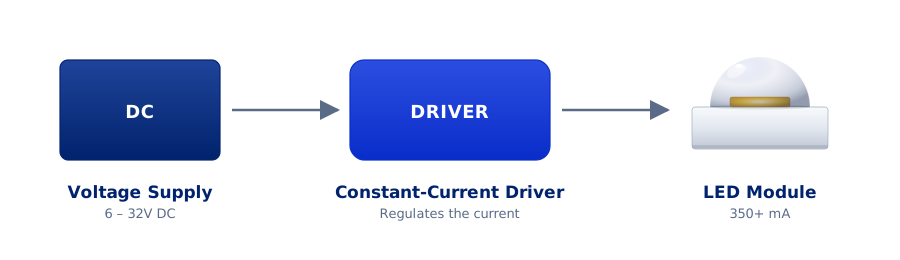
The voltage supply provides the energy. The driver regulates the current. The LED produces the light. Removing the driver from this chain is what causes failures.
BuckPuck AC drivers are the exception — they accept 120VAC directly and handle both voltage conversion and current regulation internally.
What About Resistors?
A resistor in series with an LED and a voltage source can limit current, but poorly. The current changes with temperature, supply voltage fluctuations, and LED aging. For indicator LEDs drawing 20mA, this is acceptable. For high-power LEDs drawing 350–1000mA, the thermal instability makes resistors unreliable.
Use a constant-current driver. See our Driver Selection Guide for choosing the right one.
Quick Summary
| Source Type | Holds Fixed | LED Outcome |
|---|---|---|
| Constant voltage (no driver) | Voltage | Current is uncontrolled → thermal runaway → LED death |
| Resistor + voltage | Approximate current | Current drifts with temperature → unstable, risky at high power |
| Constant-current driver | Current | Voltage adjusts automatically → stable, safe, long LED life |